Adaptive Flow for High-Mix, Low-Volume Manufacturers
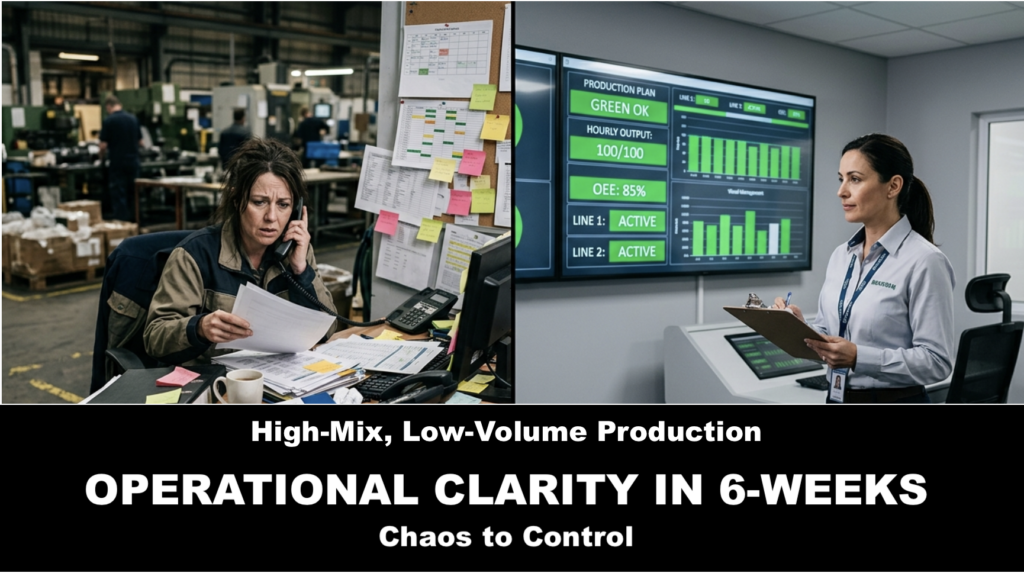
Transform your high-mix, custom operation from chaotic firefighting to flexible, setup-efficient production. This 6-week program uses Adaptive Heijunka, SMED, and dynamic Kanban to create a controlled, predictable heartbeat.
The Problem HMLV Manufacturers Face:
High-mix, low-volume manufacturers face a different kind of chaos — unpredictable demand, constant changeovers, and a constant feeling of being behind.
The symptoms are unique to HMLV:
- Every rush job disrupts the schedule
- Changeovers consume more time than actual production
- WIP builds up between bottlenecks with no visibility
- A reactive culture where the loudest customer gets served first
You’ve tried job costing. You’ve tried scheduling software. But the chaos keeps returning.
The difference is an adaptive daily rhythm — not a rigid system designed for repetitive production.
The HMLV Solution: Adaptive Heijunka, SMED, and Dynamic Flow
What You’ll Learn:
Adaptive Heijunka (Not Traditional Heijunka): Traditional Heijunka assumes demand can be leveled. In HMLV, demand is unpredictable. Adaptive Heijunka creates flexibility within the batching structure — demand buckets, dynamic WIP limits, and setup fees that protect your capacity.
SMED for High-Mix, Frequent Setups: In HMLV, changeovers are constant. SMED doesn’t just reduce changeover time — it makes frequent changeovers economically viable. Every setup reduction unlocks capacity you didn’t know you had.
Dynamic Kanban: Fixed Kanban works in high-volume environments. HMLV requires dynamic WIP limits that adapt to batch size, routing complexity, and customer priority. Dynamic Kanban keeps WIP manageable without over-constraining flexibility.
Daily Setup Rhythm: Green/Red hourly assessments with HMLV-specific disruption categories. A discipline of daily visibility that prevents small batches from becoming big problems.
Your 6-Week HMLV Program
Week 1 — The HMLV Foundation
Day 1 — HMLV Principles: Learn why traditional lean tools fail in high-mix environments.
Day 2 — Routing Flexibility Assessment: Map your current routing complexity and identify opportunities for flexibility.
Day 3 — Dynamic Kanban Introduction: Replace fixed Kanban with demand-adapted WIP limits.
Day 4 — Setup Assistant Program: Develop a structured approach to tooling prep between jobs.
Day 5 — Adaptive Heijunka Framework: Create demand buckets that accommodate high-mix variability.
Week 2 — SMED for High-Mix, Frequent Setups
Day 1 — The True Cost of Setups: Calculate total setup time per week and its impact on capacity.
Day 2 — Internal vs. External Setup: Separate what can be prepared while the machine runs from what requires a stop..
Day 3 — SMED for HMLV: Apply SMED principles adapted for high-mix — multiple products, frequent changeovers..
Day 4 — Setup Preparation Protocol: Stage tooling, fixtures, and materials before every changeover.
Day 5 — Adaptive Scheduling with SMED: Integrate faster changeovers into your adaptive scheduling rhythm.
Week 3 — Routing Flexibility and Dynamic WIP
Day 1 — Routing Analysis: Identify which products share routes and where pooling opportunities exist.
Day 2 — Dynamic WIP Limits: Set WIP limits that adapt to batch size and routing complexity.
Day 3 — Batch Size Optimization: Find the economic batch size that balances setup cost against carrying cost.
Day 4 — Demand Buckets and Setup Fees: Negotiate demand grouping with customers to reduce setup frequency..
Day 5 — Dynamic Flow Design: Build the adaptive flow system that handles your highest-mix products.
Week 4 — OEE and Setup Frequency for HMLV
Day 1 — OEE Recalibration: Measure true OEE for a high-mix, low-volume environment.
Day 2 — Setup Frequency Index (SFI): Introduce an HMLV-specific metric — setup frequency per shift and its cost.
Day 3 — OEE Losses in HMLV: Focus on changeover losses, routing variability, and small batch quality issues.
Day 4 — Daily SFI Tracking: Build a daily tracking rhythm for setup frequency and impact on throughput.
Day 5 — OEE + Adaptive Heijunka: Connect OEE metrics to dynamic scheduling decisions.
Week 5 — Standardized Reaction Protocols for HMLV
Day 1 — Top 5 HMLV Disruptions: Identify the 5 most common disruptions in your operation (rush jobs, late materials, tooling failures, etc.)..
Day 2 — Dynamic Escalation Tree: Build an escalation tree that adapts to job priority and customer urgency.
Day 3 — Tier Meeting Structure: Standardize tier meeting rhythms for a high-mix environment.
Day 4 — Green/Red at Shift Start: Build Green/Red assessment into shift handoff with HMLV-specific criteria.
Day 5 — Reaction Protocol Documentation: Lock the top 5 responses into a standard reference board.
Week 6 — Sustaining Adaptive Flow
Day 1 — Designing the Permanent Adaptive Kanban Board: Build the visual board that handles demand variability.
Day 2 — Monthly Adaptive Review: Lock in a monthly review cadence for demand buckets and WIP limits.
Day 3 — Customer Demand Negotiation: Develop tactics to negotiate demand grouping and setup fees.
Day 4 — Designing the Permanent Board: Finalize the visual management system for your operation.
Day 5 — Graduation: Present the Before vs. After results and the 90-Day Roadmap.
Who This Is For:
This program is designed for HMLV manufacturers, including:
- Job shops and machine shops
- Custom fabrication
- Medical device manufacturing
- Aerospace precision manufacturing
- Prototype and short-run production
Prerequisites: A production operation with at least one defined bottleneck, a team willing to track hourly data, and leadership committed to a daily rhythm over project-based improvement.
Results You Can Expect: By the end of 6 weeks:
- Visible heartbeat — Real-time production status visible to every team member, every hour
- Reduced setup time — SMED implementation targeting 50%+ reduction in changeover time
- Flexible flow — Adaptive Heijunka that handles demand variability without daily chaos
- Dynamic WIP control — WIP limits that adapt to batch size and routing complexity
- OEE improvement — Measurable gains in Availability, Performance, and Quality
- Setup frequency managed — Setup Frequency Index tracking that makes the setup cost visible
- Green/Red discipline — Standard reaction to disruptions before they escalate
- 90-Day Roadmap — A sustainment plan to continue improvement after Week 6
Ready to Control Your High-Mix Operation?
The HMLV program runs for 6 weeks with your team. Daily activities, guided facilitation, and measurable milestones — designed for high-mix manufacturers ready to move from chaos to control.
Price:
Self-Paced Online Course: $2,500 per team (maximum of 10 participants)
Consultant Supported Online Course: $5,000 per week, per team (maximum of 10 participants)
Consultant Onsite Training: $10,000 per week, per team (maximum of 10 participants)