Leveled Production for High-Volume, Low-Mix Manufacturers
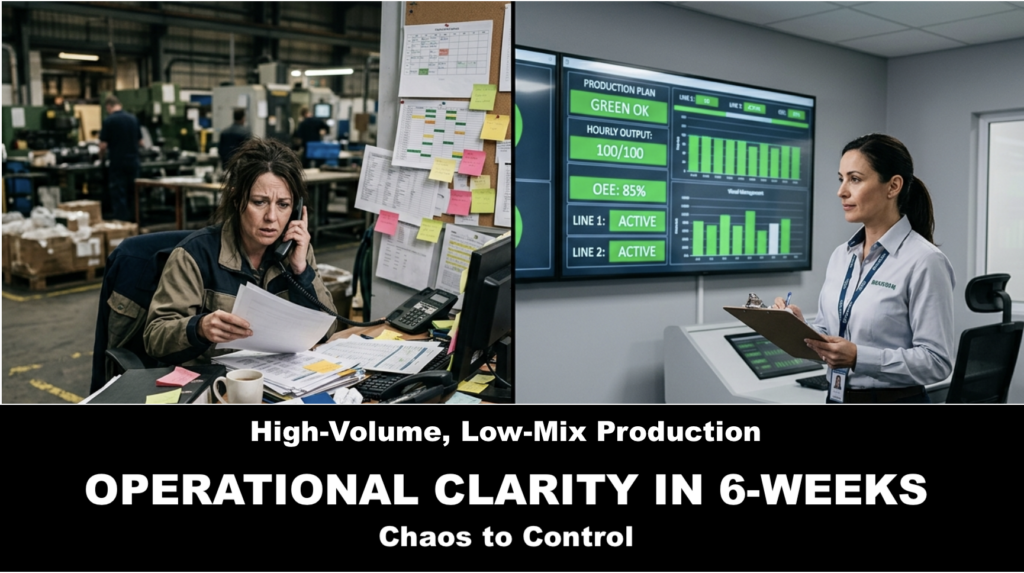
Transform your high-volume operation from reactive firefighting to predictable, leveled production. This 6-week program uses Heijunka, SMED, and Theory of Constraints to create a controlled heartbeat your team can run by.
The Problem HVLM Manufacturers Face:
Most high-volume manufacturers look stable — but beneath the surface, demand spikes, changeover chaos, and unprotected bottlenecks create the same firefighting culture you see in job shops.
The symptoms are familiar:
- Month-end demand surges that crush your team
- Changeovers that eat hours of productive time
- Bottlenecks that become the enemy of your entire operation
- A reactive culture where every day feels like an emergency
You’ve implemented OEE. You’ve done Kaizen events. But the chaos keeps returning.
The difference is systematic, daily rhythm — not project-based improvement.
The HVLM Solution: Heijunka, SMED, and Constraint Management
What You’ll Learn:
Heijunka (Production Leveling): Smooth demand fluctuations so your team isn’t scrambling to react to customer swings. Level the schedule daily, weekly, and monthly.
SMED (Single-Minute Exchange of Die): Reduce changeover time — even in high-volume environments where changeovers seem “too frequent to bother.” SMED makes changeovers fast enough to enable leveling.
Theory of Constraints (TOC): Identify and protect your bottleneck. Stop it from becoming the constraint that limits your entire operation’s output.
Daily Reaction Standards: Green/Red hourly assessments. Reason codes at every Red. A discipline of daily visibility that prevents problems from becoming crises.
Your 6-Week HVLM Program
Week 1 — The Leveled Rhythm
Day 1 — Heijunka Principles: Learn the difference between reactive scheduling and leveled scheduling.
Day 2 — Daily Leveling Tactics: Create a level-loaded weekly schedule.
Day 3 — Green/Red Thinking: Establish binary success criteria. Green = day was leveled. Red = demand deviated.
Day 4 — Root Cause at the Board: Require a Reason Code for every Red hour.
Day 5 — The Weekly Rhythm: Design your weekly Heijunka board.
Week 2 — SMED for High-Volume Lines
Day 1 — The True Cost of Changeovers: Map your current changeover time and calculate the daily impact.
Day 2 — Internal vs. External Setup: Separate what can be done while the line runs from what requires a stop.
Day 3 — Quick Changeover Principles: Apply SMED to reduce your changeover time.
Day 4 — Changeover Preparation Protocol: Pre-stage tooling and materials before the changeover begins.
Day 5 — Heijunka + SMED: Integrate leveled scheduling with faster changeovers.
Week 3 — Protecting the Bottleneck
Day 1 — Theory of Constraints Introduction: Identify your constraint — the one machine, process, or resource that limits your output.
Day 2 — Drum-Buffer-Rope System: Create a buffer before your bottleneck and link its pace to customer demand.
Day 3 — Buffer Management: Set and maintain the right-sized buffer to protect bottleneck throughput.
Day 4 — Bottleneck Protection Protocol: Develop a standard reaction when the bottleneck is threatened.
Day 5 — Demand Spike Response: Design a Heijunka response when a customer surges demand.
Week 4 — OEE for HVLM
Day 1 — OEE Recalibration: Measure true OEE using Availability × Performance × Quality.
Day 2 — Demand Volatility Index (DVI): Introduce a metric specific to HVLM — how much demand fluctuates week to week.
Day 3 — OEE Losses in HVLM: Focus on minor stops, reduced speed, and unplanned downtime.
Day 4 — Daily OEE Tracking Cadence: Design an hourly OEE review rhythm.
Day 5 — OEE + Heijunka Integration: Connect OEE metrics to leveled scheduling decisions.
Week 5 — Standardized Reaction Protocols
Day 1 — Top 5 HVLM Disruptions: Identify the 5 most common disruptions in your operation.
Day 2 — Escalation Tree: Build a visual escalation tree — what gets handled at each level before it escalates.
Day 3 — Tier Meeting Structure: Standardize tier meeting rhythms — what gets reviewed, when, by whom.
Day 4 — Green/Red at Shift Start: Build the Green/Red assessment into shift handoff.
Day 5 — Reaction Protocol Documentation: Lock the top 5 responses into a standard reference board.
Week 6 — Sustaining Leveled Flow
Day 1 — Designing the Permanent Heijunka Board: Build the visual board that stays on the shop floor.
Day 2 — Monthly Scheduling Rhythm: Lock in a monthly leveling review cadence.
Day 3 — Customer Demand Negotiation: Develop tactics to negotiate even demand with key customers.
Day 4 — Designing the Permanent Board: Finalize the visual management system for your operation.
Day 5 — Graduation: Present the Before vs. After results and the 90-Day Roadmap.
Who Is This Course For?
This program is designed for HVLM manufacturers, including:
- Automotive and Tier suppliers
- Consumer electronics assembly
- Appliance manufacturing
- Food and beverage production
- Packaging operations
Prerequisites: A production operation with at least one defined bottleneck, a team willing to track hourly data, and leadership committed to a daily rhythm over project-based improvement.
Results You Can Expect: By the end of 6 weeks:
- Visible heartbeat — Real-time production status visible to every team member, every hour
- Leveled demand — Demand spikes are reduced through daily Heijunka practices
- Reduced changeover time — SMED implementation targeting 50%+ reduction
- Protected bottleneck — Drum-Buffer-Rope system maintaining constraint throughput
- OEE improvement — Measurable gains in Availability, Performance, and Quality
- Green/Red discipline — Standard reaction to disruptions before they escalate
- 90-Day Roadmap — A sustainment plan to continue improvement after Week 6
Ready to Level Your Production?
The HVLM program runs for 6 weeks with your team. Daily activities, guided facilitation, and measurable milestones — designed for high-volume manufacturers ready to move from chaos to control.
Price:
Self-Paced Online Course: $2,500 per team (maximum of 10 participants)
Consultant Supported Online Course: $5,000 per week, per team (maximum of 10 participants)
Consultant Onsite Training: $10,000 per week, per team (maximum of 10 participants)